Guide · 6 min read
What games get a 70th birthday party talking?
Games about 1956, the year the guest of honor was born: its songs, TV shows, news and prices. Open with a mingle bingo as guests arrive, play the trivia in mixed teams with three choices for every question, and close with old sayings the whole room finishes together. Every answer turns into a story about the birthday guest.
Updated October 20, 2026 · Selenby Puzzles
A 70th birthday party has its subject built in: the guest of honor and the year they were born. For a 70th in 2026, that year is 1956, the year of Elvis on television, the new Interstate highways and the 3-cent stamp. The games below get the room talking about that year, and then about the person who was born in it. Here’s what to play, in what order, for a family dinner of ten or a hall of sixty.
1956 trivia questions and answers
These eight come from our 1956 Trivia: Turning 70, two from each of its four rounds, copied exactly as the Host Pack prints them, answers included. Read the question and the three choices aloud, twice if it helps, and wait for the room before you read the answer.
Music & Movies
Who wrote and first recorded ‘Blue Suede Shoes,’ released on Sun Records in January 1956? A. Buddy Holly · B. Carl Perkins · C. Chuck Berry (Answer: B, Carl Perkins.)
Which Sun Records singer scored his first No. 1 country hit in 1956 with ‘I Walk the Line’? A. Hank Williams · B. Willie Nelson · C. Johnny Cash (Answer: C, Johnny Cash.)
TV & Radio
Which sitcom was Nielsen’s No. 1 show of the 1956–57 TV season? A. I Love Lucy · B. The Andy Griffith Show · C. The Beverly Hillbillies (Answer: A, I Love Lucy.)
Which colorful bird did NBC introduce in 1956 to promote its color broadcasts? A. A parrot · B. A peacock · C. A flamingo (Answer: B, A peacock.)
News & Firsts
Which 13-year-old chess prodigy won the ‘Game of the Century’ in October 1956? A. Garry Kasparov · B. Boris Spassky · C. Bobby Fischer (Answer: C, Bobby Fischer.)
The famous ‘Million Dollar Quartet’ photo of December 1956 was taken at which studio? A. Motown · B. Sun Studio · C. Abbey Road (Answer: B, Sun Studio.)
Everyday Life & Prices
On March 1, 1956, the federal minimum wage went up to what hourly rate? A. $0.25 · B. $2.50 · C. $1.00 (Answer: C, $1.00.)
How many stars were on the United States flag in 1956? A. 50 · B. 46 · C. 48 (Answer: C, 48.)
Every answer in the Host Pack comes with a fun fact and a question for the table. After Blue Suede Shoes, the fun fact is that it was Sun Records’ first million-seller, and the question is “What was the fanciest pair of shoes you owned as a teenager?” After the minimum wage: “What was your very first job, and what did it pay?” Eight more questions, different from these, are on our page of 70th birthday games for someone born in 1956.
A 70th birthday party plan
Our 70th Birthday Games Bundle puts 1956 Trivia, Which Came First and Old Fashioned Sayings in one download, and its Start Here guide plans the afternoon around the cake. Add a mingle bingo at the door and the whole party is planned:
| When | Game | About |
|---|---|---|
| As guests arrive | Find the Guest Bingo | 10 to 15 minutes |
| Before the cake | 1956 Trivia, rounds 1 and 2 | 15 minutes |
| While the tea goes round | Which Came First, A or B | 25 minutes |
| After the cake | Old Fashioned Sayings: the guest of honor finishes them first | 20 minutes |
| If the room wants more | 1956 Trivia, rounds 3 and 4, and the champion’s certificate | 15 minutes |
| To close | The Then & Now keepsake and the Birthday Star certificate | A few minutes |
You can host the bundle without a pair of scissors: every game can be read aloud from its Host Pack, and the slide decks put every question on a television.
As guests arrive: a mingle bingo
A 70th brings together people from every part of a life: old school friends, former coworkers, neighbors, in-laws and grandchildren. In Find the Guest Bingo, every square finishes “Find someone who…”, such as “can whistle a tune”, and guests collect initials from people who fit. It has 16 different cards in two sizes, 8 Large Print and 8 Classic, and a first BINGO usually comes in about 5 minutes. The winner reads the line aloud, and each signer tells the story of their square. If the party is seated, play Hands Up: you read the squares, everyone a square fits raises a hand, and nobody walks or writes.
Over the meal: the 1956 trivia
The Host Pack’s advice for a mixed party is to spread the oldest guests across the teams, one per team if you can, and let the youngest player read the answers aloud. Then:
- Seat tables of three to six as teams, one answer sheet per table, or hand out A, B and C paddles.
- Open with the Host Pack’s welcome: “Today we’re going back to 1956, the year ______ was born.” Fill in the name.
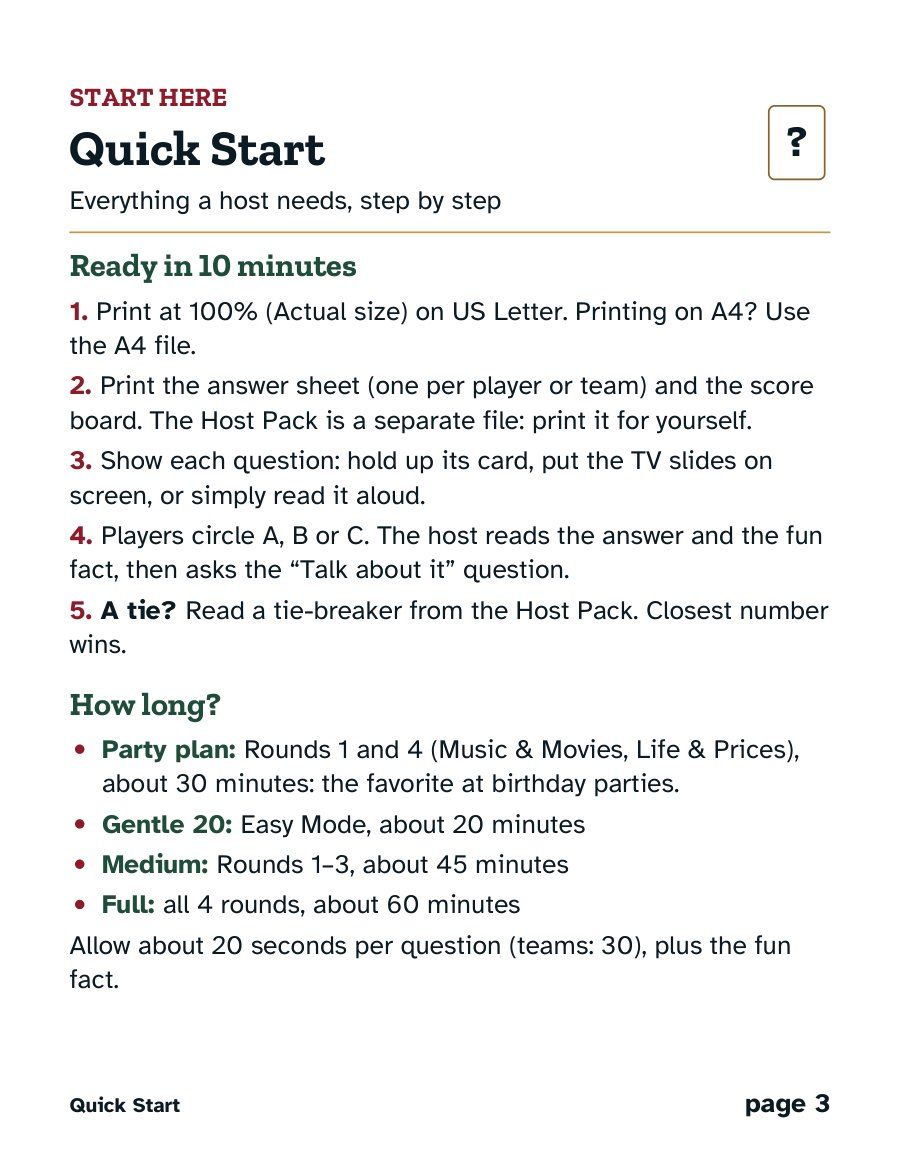
- Allow about 20 seconds per question, or 30 for teams, then read the answer and the fun fact.
- Give the birthday bonus. The guest of honor may “phone a friend” once per round. As the Host Pack puts it, stories count more than points.
- Keep a tie-breaker ready. There are five; the closest number wins.
The party plan uses rounds 1 and 4, Music & Movies and Everyday Life & Prices, about 30 minutes in all: the Host Pack calls them the favorite at birthday parties. For a shorter game, the Gentle 20 is the friendliest 20 questions in about 20 minutes; all four rounds take about an hour.
While the tea goes round: Which Came First
Not every guest was alive in 1956, and that’s fine. Which Came First for Older Adults asks which of two things from everyday American life came first, from the 1870s to the 1980s. Every pair is at least 15 years apart, so a grandchild can reason it out while a grandparent remembers it. There are 50 questions in five rounds, each with a fun fact and a “Talk about it” prompt. Our guide on how to play Which Came First has the rules and sample questions.
After the cake: sayings everyone knows
The bundle’s guide is honest about the family party: “the grandchildren will lose the trivia and win the sayings.” Old Fashioned Sayings has 60 classic sayings to finish out loud, each with its meaning and where it comes from. You read “Don’t count your chickens…” and the room says the rest. Let the guest of honor go first. Our guide to the finish the phrase game covers how to run it.
Small party or big party
A dinner of ten: read everything aloud from the Host Packs; two people are enough to play. You may only get through half the questions, and that’s a good sign.
A hall of sixty: seat tables of six as teams and put the questions on a TV. The 1956 Trivia slide deck has 147 slides, so nobody squints at a card, and a runner can collect answer sheets while the next round is read.
Making it about the birthday guest
The trivia sets the scene; the guest of honor is the subject. Now and then, turn to them, as the Host Pack suggests, and ask: “What was it like when you were growing up?”
The game file ends with two pages to give away. The Birthday Star certificate reads “Officially Vintage since 1956”. The Then & Now keepsake sets eight everyday prices from 1956 beside today’s, for example:
| 1956 | Today | |
|---|---|---|
| First-class stamp | 3¢ | 82¢ |
| Gallon of gas | about 30¢ | over $4 |
| Minimum wage, one hour | $1.00 | $7.25 |
| Dozen large eggs | about 60¢ | about $2.27 |
“Today” means U.S. averages for August and September 2026. Read it aloud while the cake is cut, then hand it to the guest of honor.
Comfort and access
- Seeing. Trivia question cards print at 38 pt or larger, the Which Came First cards at 60 pt and up, and each saying at 76 pt or larger. Body text is 18 pt. Print one page at Actual size (100%) first; our guide on printing at actual size covers every app.
- Hearing. Seat older guests close to the host, read each question twice, and face the room.
- Hands. Paddles instead of pencils; nothing in the bundle needs cutting.
- Choice. Anyone may pass on any question. Nobody is keeping score of who knew what.
A 70th comes once. For other milestone years, see our milestone birthday games and the guides to 60th and 80th birthday party games.