Guide · 5 min read
How do you play the Which Came First game?
In the Which Came First game, the host reads two events, A and B, and players decide which one happened first; then the host reads both years and a fun fact. Play alone or in teams of two to four with an answer sheet, or in Easy Mode, where everyone holds up an A or B paddle and nobody keeps score.
Updated October 20, 2026 · Selenby Puzzles
Which Came First is the gentlest trivia game there is: nobody has to remember a date or dig for a name. Two events are read out, A and B, and the question is only which one happened first. A grandchild can reason it out, a grandparent may simply remember it, and both years are read aloud at the end, so every answer teaches the room something. Here are the rules, five real questions with their answers, and the editions we make.
What is the Which Came First game?
Which Came First is a two-choice trivia game: each question names two events, A and B, and players decide which happened first. The host then reads both years, a fun fact, and a “Talk about it” question for the table. In our older adults and holiday editions the two events lie at least 10 to 22 years apart, depending on the edition, so a right answer never turns on a few months.
How to play, step by step
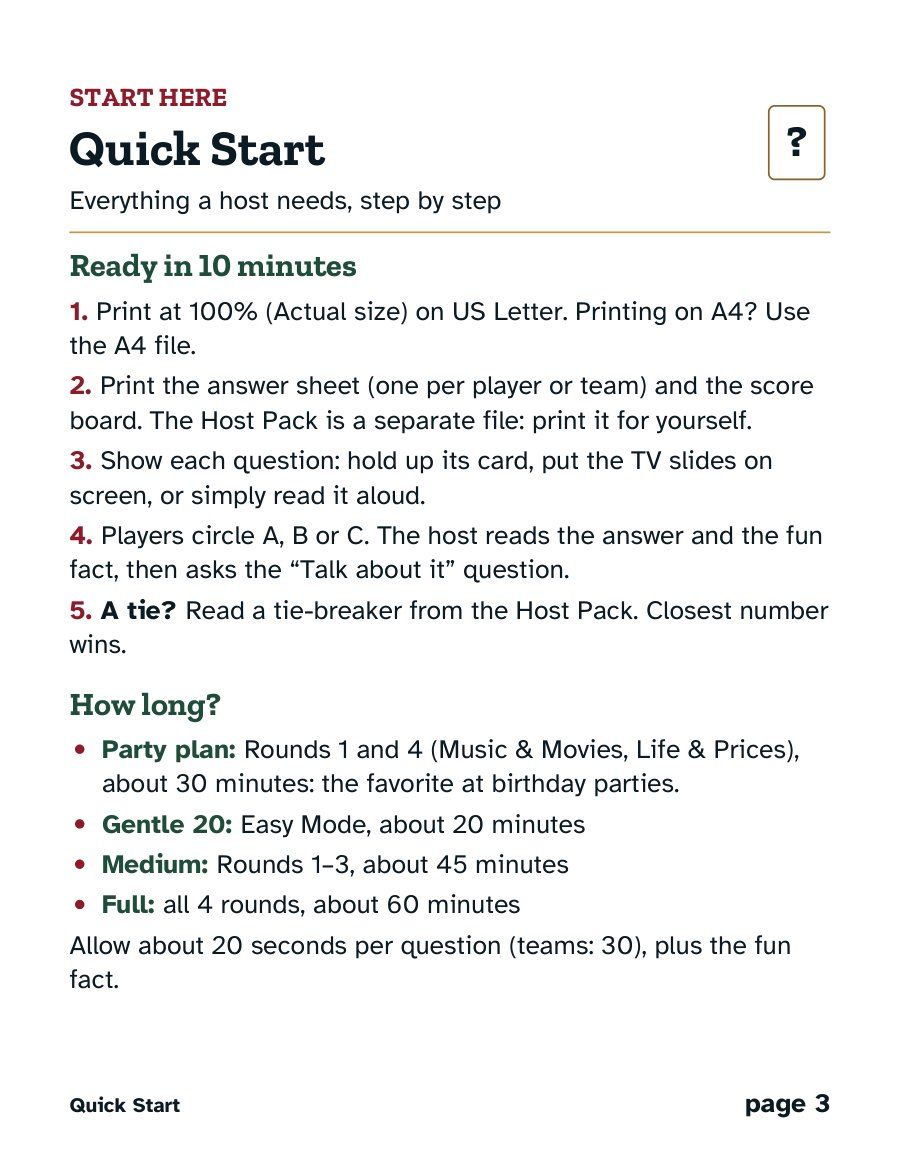
- Print the display cards and the answer sheets, or open the TV slides. Teams of two to four share one answer sheet.
- Choose when to reveal the answers: after each question, which is best for gentle groups and families, or at the end of each round, for competitive groups.
- Say the number and ask “Which came first?” Read A, then B, and hold up the card or show the slide.
- Wait about 20 seconds, or 30 for teams.
- Read the answer and the fun fact. Read both years, so everyone hears how far apart the two events were.
- Ask the “Talk about it” question if there is time. There are no wrong answers to it.
- At the end of each round, players swap sheets with a neighbor, mark the right answers and write the round’s points. Copy the scores to the Score Board.
- Break a tie with a tie-breaker: each tied player writes down a year, and the closest year wins.
Five Which Came First questions with answers
These come from four of our games, copied exactly as the Host Packs print them.
Which came first? A. Lindbergh’s solo flight to Paris · B. Star Trek premieres on TV (Answer: A. Lindbergh’s flight 1927, Star Trek 1966.)
Which came first? A. The Golden Gate Bridge opens · B. Gilligan’s Island premieres (Answer: A. The Golden Gate Bridge 1937, Gilligan’s Island 1964.)
Both are from Which Came First for Older Adults. The Host Pack’s fun fact for the bridge: about 200,000 people walked across the Golden Gate Bridge on its opening day.
Which came first? A. Dickens’ “A Christmas Carol” · B. “Miracle on 34th Street” (original film) (Answer: A. “A Christmas Carol” 1843, “Miracle on 34th Street” 1947.)
From Christmas Trivia: Which Came First. The fun fact: the first printing of 6,000 copies of “A Christmas Carol” sold out by Christmas Eve 1843.
Which came first? A. “Mary Had a Little Lamb” first printed · B. “Green Acres” TV series premieres (Answer: A. “Mary Had a Little Lamb” 1830, “Green Acres” 1965.)
From Thanksgiving Trivia: Which Came First, where the question for the table is “What rhyme or song from your school days can you still recite?”
Which came first? A. “The Twilight Zone” premieres · B. Orson Welles’ Martian radio broadcast (Answer: B. The radio broadcast 1938, “The Twilight Zone” 1959.)
From Halloween Trivia: Which Came First. The fun fact: a survey that night found only about two percent of American homes were tuned in.
Easy Mode and the Gentle 20, for seniors
Every edition has an Easy Mode for gentle groups and anyone who finds pencils hard. There are no answer sheets and no scores: each player holds up an A or B paddle, printed in the Game file, and you read the answer straight away and celebrate every guess.
The Gentle 20 is a ready list of the 20 friendliest questions in each game, for a session of about 20 minutes. The Host Pack’s tips for a senior group: sit close together, face the group, hold the card at eye level and read each item twice. And if a story turns sad, thank them warmly and move on.
Teams, scoring and close calls
For a points game, seat teams of two to four with one answer sheet each. After every round, sheets go to a neighbor for marking, and the totals go on the Score Board. Arguments are rare, because every pair is far apart: at least 15 years in the older adults edition, 12 in Christmas, 22 in Thanksgiving and 10 in Halloween, and every year was checked against published sources. Some answers carry a note, such as a year in Japan and a later one in the U.S., and the Host Pack prints both.
How long does a game take?
| Edition | Questions | Rounds | Full game | Gentle 20 |
|---|---|---|---|---|
| Which Came First for Older Adults: everyday American life, 1870s to 1980s | 50 | 5 | About 75 minutes, or two sessions | About 20 minutes |
| Christmas Trivia: Which Came First: carols, films and traditions | 40 | 4 | About 50 minutes | About 20 minutes |
| Thanksgiving Trivia: Which Came First: food, parades and football | 40 | 4 | About 50 minutes | About 20 minutes |
| Halloween Trivia: Which Came First: candy, costumes, monster films and songs | 40 | 4 | About 50 minutes | About 20 minutes |
| Church History: Which Came First: Bibles in English, hymns, Sunday school, missions | 40 | 4 | About 50 minutes | About 20 minutes |
Two rounds make a good half hour in any edition. The older adults edition is also inside our 70th, 80th and 90th birthday bundles, where it fills the 25 minutes while the tea goes round.
What to print
- Once, for the host: the Host Pack, and the display cards if you have no TV. Every display card prints at 60 pt and up; body text is 18 pt.
- Per team: one answer sheet. In Easy Mode, one A and one B paddle per player instead.
- Or nothing at all: open the TV slides, which show each question and then its answer.
Black ink is enough, on US Letter or A4. Print one page at Actual size (100%) first; our guide on printing at actual size covers every app. For more ways to play with an older group, see our finish the phrase guide and all our games for seniors.