Guide · 6 min read
What is a good printable logic puzzle for adults?
A good printable logic puzzle for adults has plain rules, no guessing and exactly one answer you can check. Our name elimination mysteries work that way: a guest book of names, a short list of clues, and every clue strikes names out until one is left. Try the free two-minute case first, in your browser or on paper.
Updated October 20, 2026 · Selenby Puzzles
Most printable logic puzzles for adults are grids: three lists, a box for every pairing and a lot of X marks. Good ones are a pleasure, but many readers lose the thread halfway down the grid. A name elimination mystery keeps the logic and drops the bookkeeping. There is one list, the guest book, and one move, striking a name out. It reads like a small-town detective story, and like any honest detective puzzle it has exactly one answer.
How to solve one, step by step
- Read the story and look at the book. Every name in the guest book has a few facts beside it, such as age, street, trade and table number.
- Take the clues one at a time. Each clue tells you something true of the one person you’re looking for.
- Strike out every name the clue rules out. Clues rule people out, never in. Work in pencil, with a ruler under the line.
- Check your count. Each page of the book prints how many of its names should still be standing after clue 1, and check-points along the way give the running total.
- The last name standing is your answer. Turn to the Solution Pack only when you have one name left; it tells you how the story ended.
A clue from Twelve Small Cases shows how it reads: “The culprit’s first name does not end with a vowel.” Helen stays; Anna is struck out. Every reading rule, such as what “fewer letters than” means or what counts as a double letter, is spelled out with an example on the How to Play page, so a table never has to argue about a clue.
Logic grid, sudoku or name elimination?
| Logic grid puzzle | Sudoku | Name elimination mystery | |
|---|---|---|---|
| What you work with | Several lists matched on a grid | Digits 1 to 9 | One guest book of names |
| Your move | Mark yes or no in each box | Write a digit | Strike a name out |
| A story? | Usually a few lines | No | A letter, a story and an ending |
| Check yourself | At the end | At the end | A count line on every page |
| Play together? | Hard to share one grid | One solver per grid | Split the pages, one reader |
If you enjoy sudoku for its single sure answer, an elimination mystery gives you the same certainty with words and a story. If logic grids feel like accounting, this is the friendlier door into the same kind of thinking.
Try one free, on screen or on paper
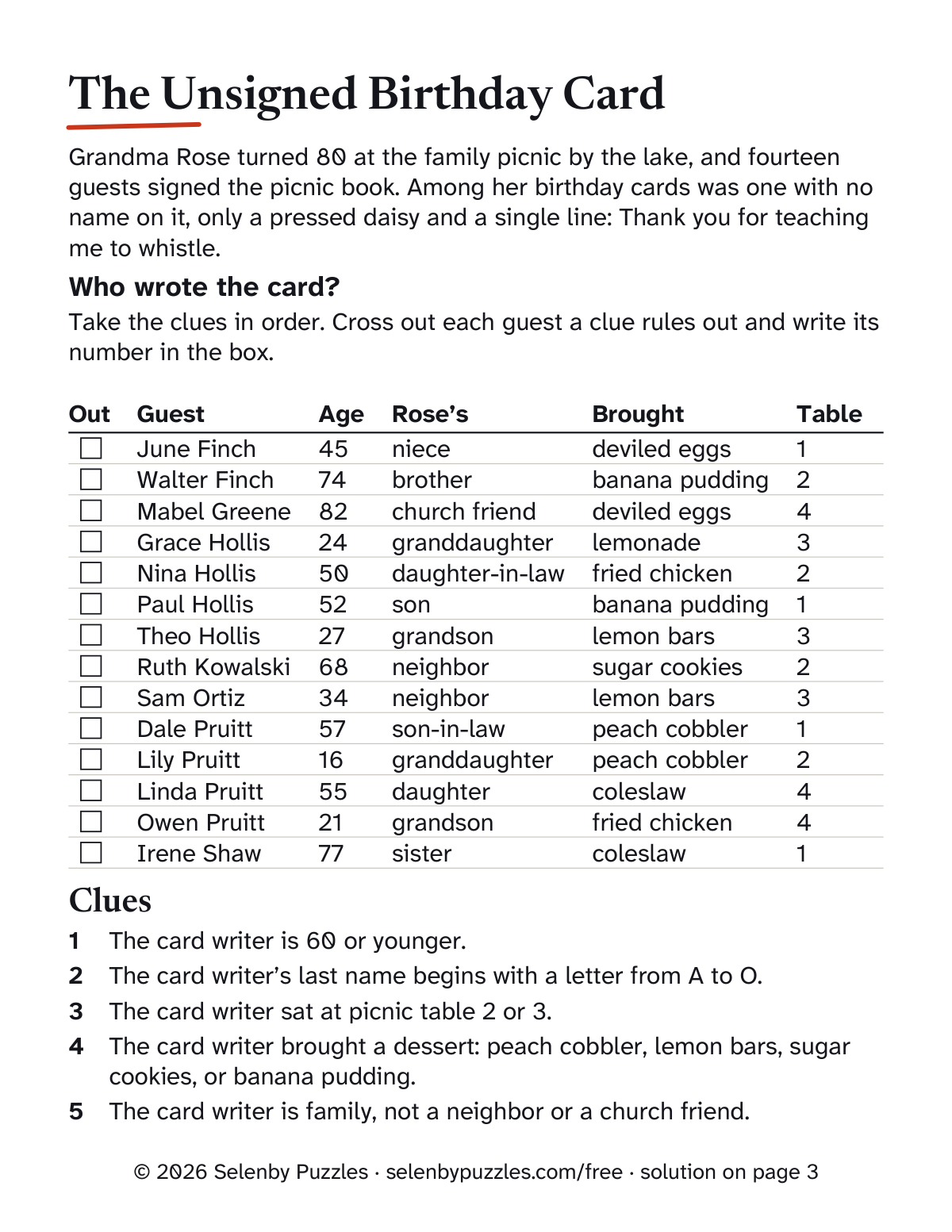
The quickest way in is the two-minute case. Fourteen guests signed the book at a family birthday picnic, and one of them left a card with no name on it. Five clues lead to exactly one name. It plays in your browser: one button crosses out the guests who don’t fit each clue, or you can tap a guest to check them first.
Prefer pencil? The same case is on our free samples page as a three-page PDF with its solution, in US Letter and A4. Print it at actual size and solve it at the kitchen table.
Choose your level
| Puzzle | Names | Clues | About how long |
|---|---|---|---|
| The two-minute case (free) | 14 | 5 | Two minutes |
| A case from Twelve Small Cases | 160 | 7 or 8 | 20 minutes at a table of four; under an hour alone |
| Quick Case edition of a full case | 800 | 12 | 30 minutes at a table of four; about an hour alone |
| Large Print edition of a full case, 16 pt | 800 | 12 | An hour at a table of four; under 2 hours alone |
| Full case, Standard edition | 2,000 | 12 or 13 | An hour at a table of four; 2 to 3 hours or more alone |
The Large Print and Quick Case editions share a chain of clues of their own over 800 names, so neither is a shortened copy of the big book; the Quick Case sets it at 10 pt. Every edition prints on US Letter and A4, and black ink is enough.
Why there’s exactly one answer
A logic puzzle is only as good as its answer. Every chain of clues in our cases is checked by program twice, the second time on the finished PDF, to confirm that exactly one name survives. Leave any single clue out and two or more names would survive, so no clue is decoration and there’s no dead end.
The puzzle also helps you catch your own slips without seeing the answer. A count line sits at the foot of every page (“Check: clue 1 leaves 31 of the 48 names on this page”), the Detective’s Log of a full case has check-points every three clues, and the Solution Pack lists the count after every clue on a page before the answer. If your number is off, you know at once to look back.
Playing with a partner or a team
Grids are solitary; a guest book shares well. In a full case, the Team Sheet splits the book’s pages between 2, 3, 4 or 6 teams. One reader reads a clue aloud, every team strikes names on its own pages, and the reader adds up the counts and compares them with the check-point. Twelve Small Cases suits 1 to 4 players a case: pass the book around the table or solve alone.
Where to start
- A gentle start: Twelve Small Cases collects twelve short mysteries from one small town, 160 names and 7 or 8 clues each, 92 clues in all. Each case is its own run of pages, so you can print one at a time.
- One full evening: a single case such as Case File No. 7: The Closing-Time Diner, where someone paid off every tab in the diner’s book and left without a word. Each full case comes in Standard, Large Print and Quick Case editions.
- For Christmas: Case File No. 2: The Christmas Star or Case File No. 4: The Caroler Who Wasn’t There.
- The whole shelf: All Nine Cases gathers the nine full cases in one download. The cases also come three at a time, as in Mysteries, Season One.
The stories are gentle: a missing recipe box, a quilt with no maker’s name, a pie nobody will own up to. Nobody is hurt, and often nobody is in trouble. Start with the free two-minute case, then browse all our name elimination mysteries.