Guide · 5 min read
How does a name elimination mystery work?
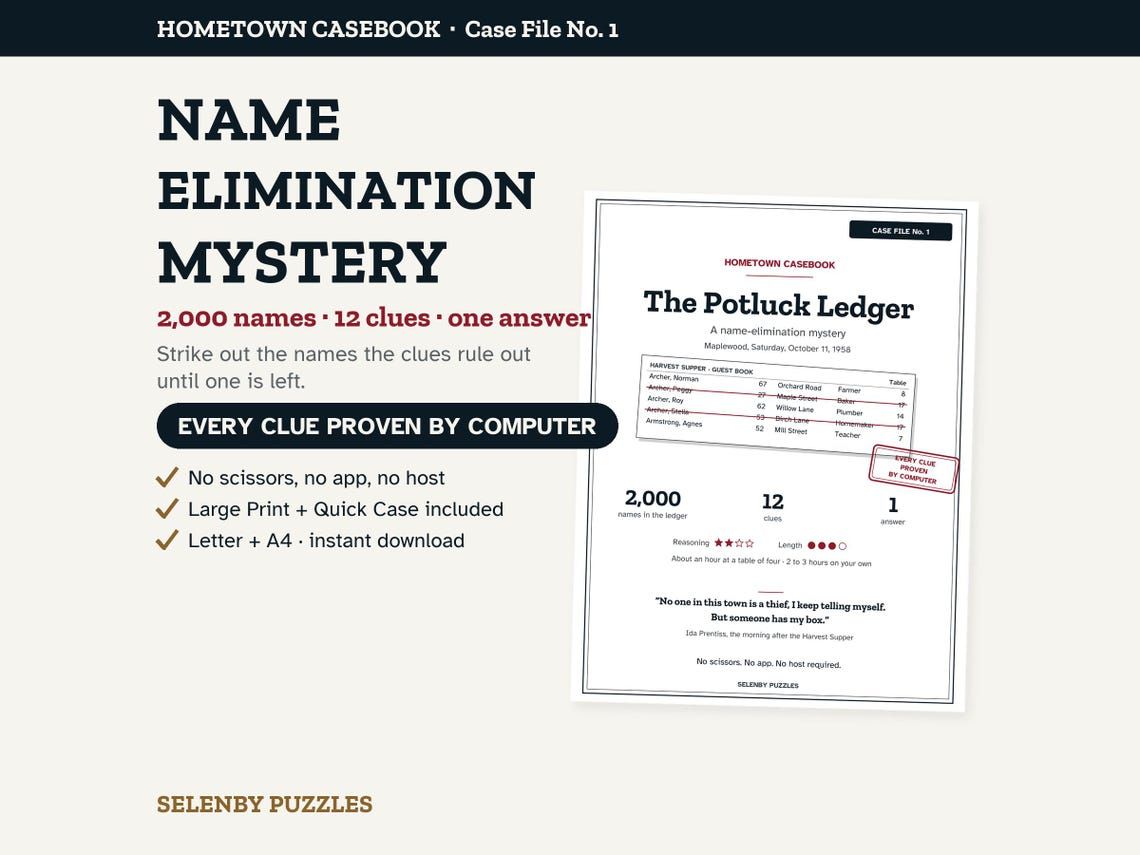
You start with a guest book full of names and a short list of clues. Each clue rules people out, never in: you strike every name it excludes, then read the next clue. After the last clue, exactly one name is left standing. Our full cases use a book of 2,000 names; the free online case has 14.
Updated October 18, 2026 · Selenby Puzzles
A name elimination mystery is a logic puzzle dressed as a small-town story. Something has gone missing, or someone has done a kindness and won’t own up to it. Everyone who was there signed a book. Your job is to find the one name that fits every clue. You don’t need to be a puzzle expert, and there’s nothing to guess. If you can read a rule and draw a line through a name, you can solve one.
The idea in one minute
- The book. You get a list of everyone who was there: a guest book, a sign-in sheet, a ledger. Each line shows a name and a few facts, such as age, table number or street.
- The clues. You get a set of clues, read one at a time.
- The strike. Each clue rules people out, never in. You draw a line through every name the clue excludes.
- The count. After each clue, fewer names are left standing.
- The answer. After the last clue, exactly one name remains. That’s your answer.
The pleasure is in the narrowing. The first clue might strike half the book. By the last few, you’re down to a handful of names, and every pencil line counts.
Try it: the two-minute case
The quickest way to understand it is to play one. Our free two-minute case runs in your browser. Fourteen guests signed the book at a family birthday picnic, and one of them left a birthday card with no name on it. Five clues lead to exactly one name.
Here’s the first clue: “The card writer is 60 or younger.” Look down the list and strike every guest over 60. Four of the fourteen are gone, and ten are still standing. Four more clues, and only one name is left.
How the clues read
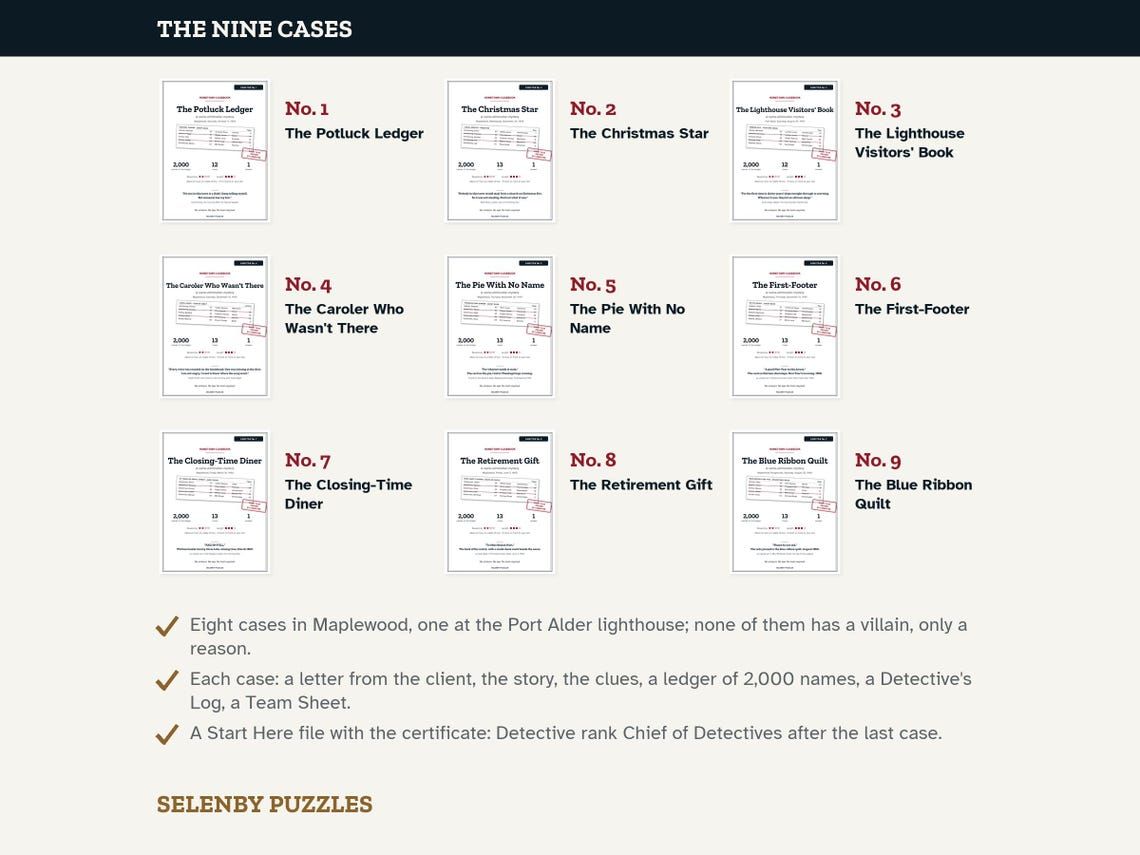
Clues in a full case use the facts printed on every line. A few examples from our first full case, The Potluck Ledger:
- “The culprit sat at table 14 or lower.” Strike everyone at table 15 and up.
- “The culprit’s first name contains the letter A.” Clara and Anna stay; Rose is struck out.
- “The culprit does not live on Cedar Avenue, Chestnut Street, Depot Street or Elm Avenue.” Strike those four streets, nobody else.
Every reading rule is spelled out with an example on the How to Play page, so there’s nothing to argue about at the table.
Why exactly one name survives
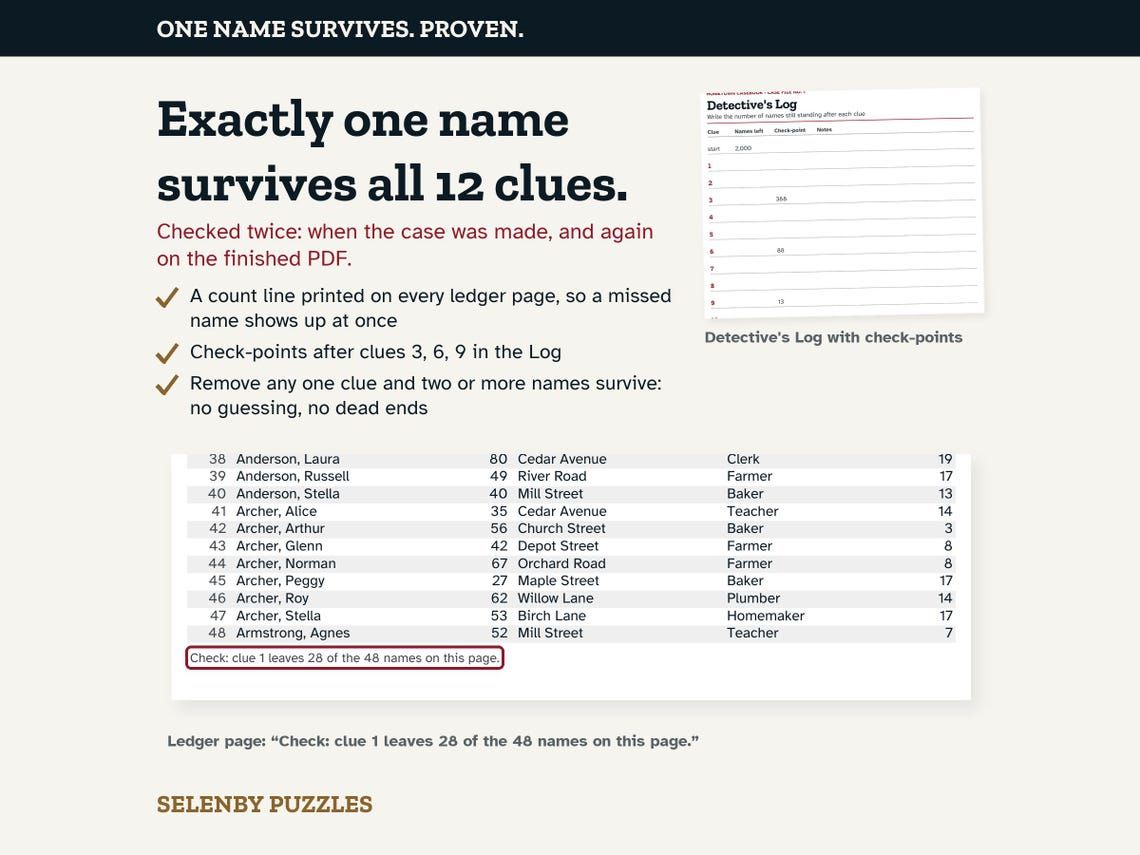
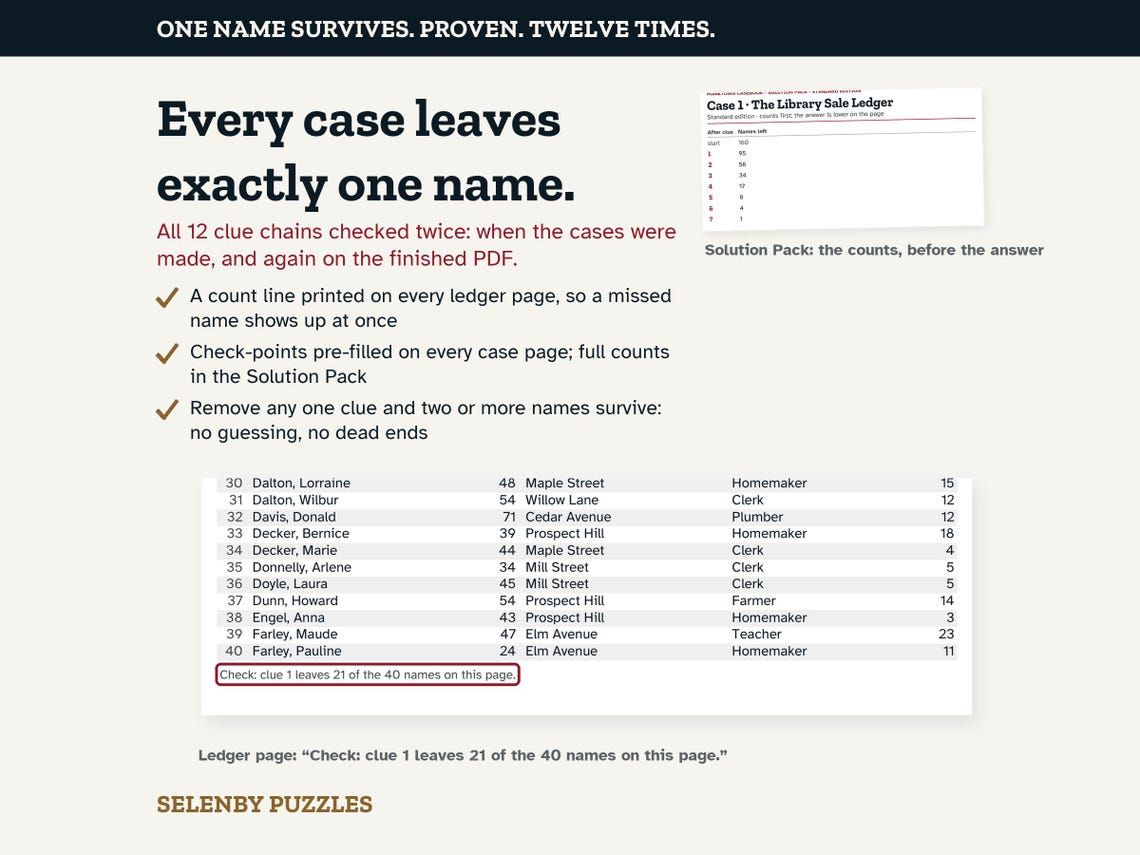
A good elimination puzzle has no dead ends and no guesses. Each of our cases is checked by program twice, the second time on the finished PDF, to confirm that exactly one name survives all the clues. Leave any single clue out and two or more names would survive, so every clue matters.
Two features help you catch your own mistakes without seeing the answer:
- A count line on every page of the book tells you how many names on that page should still be standing after a clue.
- Check-points along the way, in the Detective’s Log of a full case or on the page of a short case, let you compare your running total.
If your count is off, you know at once to look back, not twenty minutes later.
The full cases
| Full case | Short cases | |
|---|---|---|
| Names | 2,000 in the book | 160 per case |
| Clues | 12 or 13 | 7 or 8 |
| Players | 1 to 6, with a Team Sheet | 1 to 4 a case |
| Time | About an hour at a table of four | About 20 minutes a case |
| US Letter and A4 | US Letter and A4 |
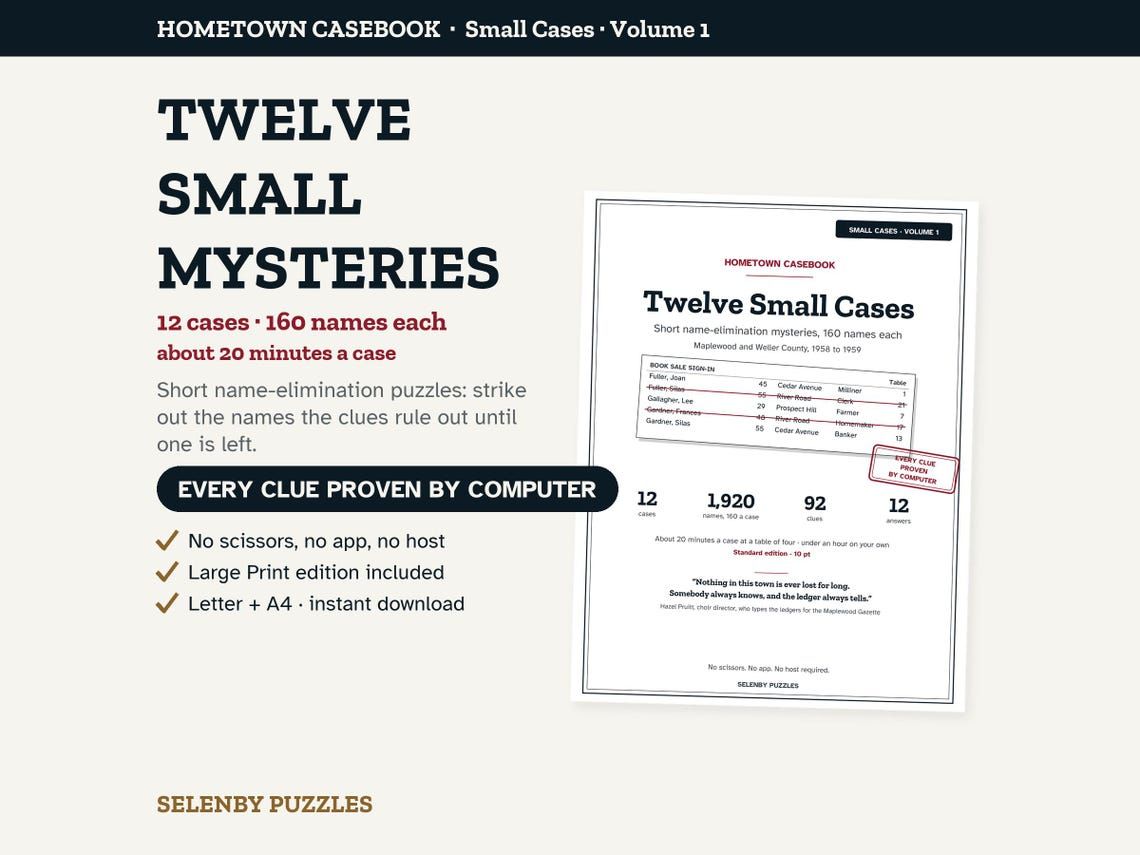
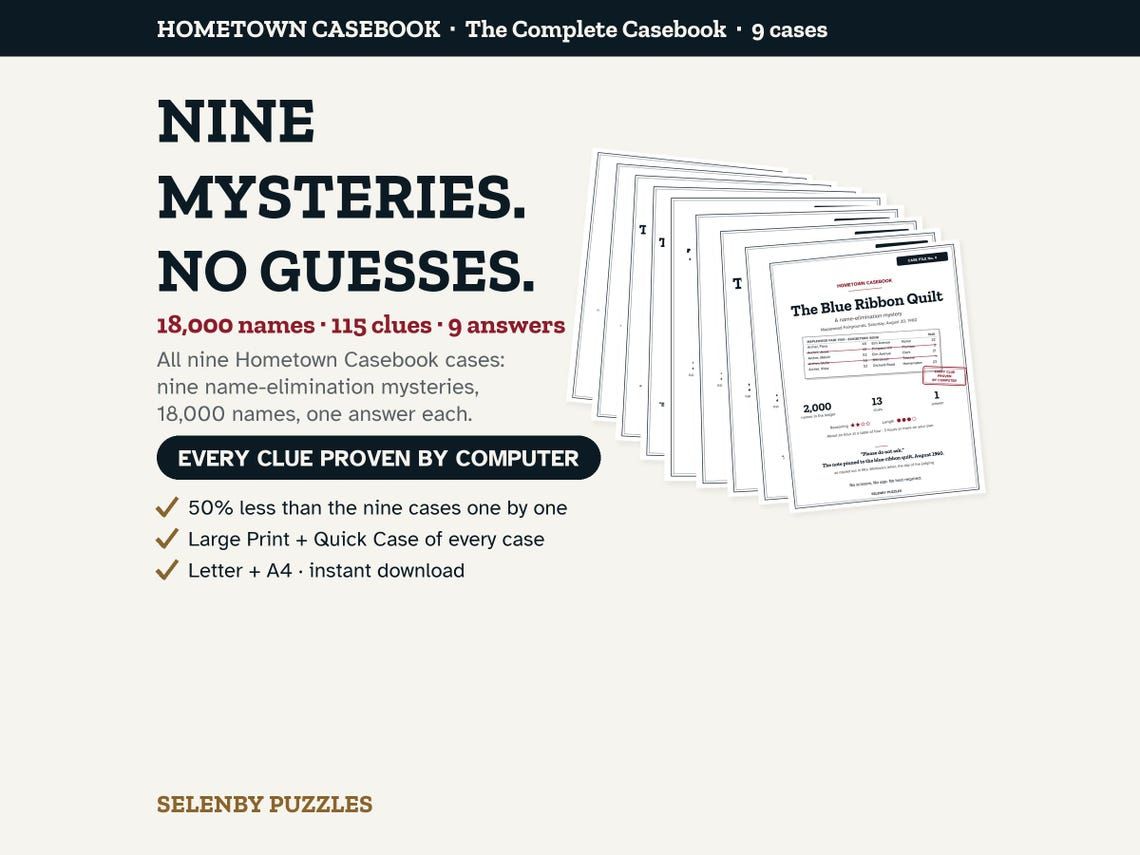
Each full case also comes in a Large Print edition at 16 pt, a separate book of 800 names with its own chain of clues, and a Quick Case of 800 names for a single evening. The standard edition is set at 10 pt. Our Twelve Small Cases collects twelve short mysteries in one download, and the Complete collection gathers all nine full cases.
Playing as a group
Elimination puzzles work well at a table, which is why book clubs, church fellowship hours and families enjoy them.
- Print one set of book pages and share them out, a few pages per player.
- One person reads each clue aloud, twice.
- Everyone strikes names on their own pages, then calls out what’s left.
- Check the counts against the count lines and the Log before moving on.
- Read the next clue together. The last clue is worth a pause before anyone says the name.
The Team Sheet keeps the group’s running count in one place.
Tips for solving
- Use a ruler under each line so your eye doesn’t slip to the row below.
- Strike lightly in pencil. A mistake is easy to undo.
- Read each clue twice before you start striking, especially words like “not,” “or lower” and “contains.”
- Keep count as you go. The count line is your friend.
The stories are gentle: a missing recipe box, a carved star, a pie with no name. Nobody is hurt, and often nobody is in trouble. Start with the free two-minute case, then browse all our name elimination mysteries.