Guide · 6 min read
Is there a clean mystery game for church groups?
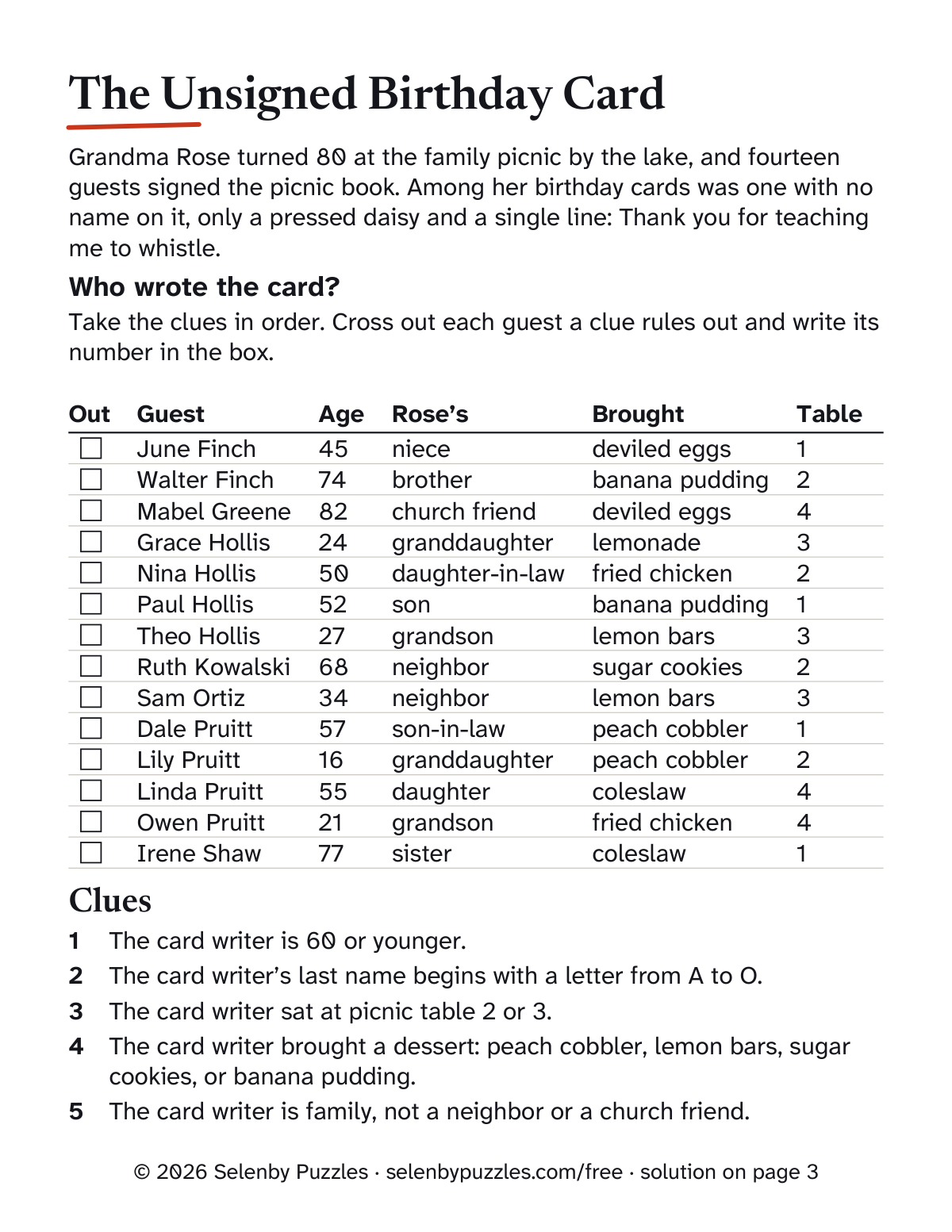
Yes. A name elimination mystery is a clean, family friendly mystery game for church groups: one person reads the clues aloud, every table strikes names out of a printed guest book, and exactly one name is left. Nobody is hurt and nobody has to act. The stories are gentle: a missing recipe box, a pie with no name.
Updated October 20, 2026 · Selenby Puzzles
Church groups ask for a mystery that’s clean all the way through: no bodies, no villains to play, nothing to explain to the youngest or the oldest at the table. A name elimination mystery is built that way. Everyone who was at a church supper, a carol service or a county fair signed a book, something small went missing or someone did a kindness in secret, and the witnesses are sure of a few things. The group reads the clues, strikes out names, and finds the one person who fits every clue.
How it differs from a party where guests play roles
Unlike a murder mystery party, nobody is hurt, nobody is handed a character to play and nobody has to perform in front of the room: the whole group solves one case together with pencils.
| Role-play mystery party | Name elimination mystery | |
|---|---|---|
| What the guests do | Play characters and question each other | Strike names out of a printed guest book |
| The story | Built around a crime | A missing star, a pie, a mended watch |
| Who can join | Usually a set number of roles | 1 to 6 a table, a copy for every table |
| Shy guests | Asked to act | Asked only to read and count |
| Preparation | Character booklets, often costumes | Print the pages; pencils and a ruler |
| The answer | Revealed by the host | Exactly one name, which the group can check |
Gentle stories, set where church people gather
Each full case is a small-town story from 1958 to 1960, with a guest book of 2,000 names. In the first three cases something small goes missing; from Case File No. 4 on, somebody does something kind and won’t own up to it.
| Case | What happened | A good fit for |
|---|---|---|
| Case File No. 1: The Potluck Ledger | A recipe box vanished from the fellowship hall during the Harvest Supper | Potlucks and fall suppers |
| Case File No. 2: The Christmas Star | The carved star left the Christmas Eve carol service under someone’s coat | Christmas parties |
| Case File No. 4: The Caroler Who Wasn’t There | One caroler slipped out of line on Carol Night; nobody fell and nothing was taken | Choir parties |
| Case File No. 5: The Pie With No Name | A pumpkin pie with no name has appeared on the dessert table for twelve Thanksgivings | Thanksgiving fellowship |
| Case File No. 6: The First-Footer | Bread, salt and coal on thirteen doorsteps, and a minister who would like to know whom to thank | Watch Night and New Year’s |
| Case File No. 8: The Retirement Gift | A retiring teacher’s gift watch vanished and came back by morning, mended | Send-offs and farewells |
The letters that open the cases set the tone. From the sexton in The Christmas Star: “So it was not stealing. Find out what it was.” From the choir director in The Caroler: “However you find them, be gentle.”
How a fellowship group plays a case
- Print one copy of the case for every table. Black ink on US Letter or A4 is enough; print at actual size so the rows of the guest book line up.
- Choose one reader for the room. The reader reads the letter and the story first, then the clues.
- Split each table’s guest book with the Team Sheet. It divides the pages between 2, 3, 4 or 6 teams, so everyone at the table has pages of their own.
- Read one clue aloud, twice. Every player strikes the names it rules out on their own pages, in pencil.
- Call the counts and add them up. Each table compares its total with the check-point in the Detective’s Log; if the total is off, a name was missed, and the table finds it before the next clue.
- Pause before the last clue. When one name is left, the reader opens the Solution Pack and reads how the story ended.
A table that finishes early can look for the hidden answer: in every full case, the name has been in plain sight since page two, and the Solution Pack says where.
How long it takes
| Edition | Names | About how long at a table of four |
|---|---|---|
| Full case, Standard (10 pt) | 2,000 | An hour |
| Large Print edition (16 pt) | 800 | An hour |
| Quick Case edition (10 pt) | 800 | 30 minutes |
| A case from Twelve Small Cases | 160 | 20 minutes |
For a fellowship hour after the service, print the Quick Case edition, or a case from Twelve Small Cases, whose own How to Play page notes that nobody in these cases comes to harm. Two of its twelve take place at First Church, on the church lawn and at the bazaar. For a full evening, play a Standard edition.
For older members and mixed ages
Every full case comes with a Large Print edition at 16 pt, with its own chain of clues over 800 names, so a table of older members can play the same story in bigger type. Nothing needs cutting, there’s no app, and the only skills are reading and counting. For a table that mixes ages, Twelve Small Cases is the gentlest start: 160 names and 7 or 8 clues a case.
Which set to buy for the year
Holiday Mysteries, Season Two holds the three holiday cases, Caroler, Pie and First-Footer, one for each gathering from Thanksgiving to New Year’s. All Nine Cases gathers every full case in one download, enough for a year of fellowship evenings.
Want to try the format with your group first? Play the free two-minute case together on a screen, or print it from our free samples. For more ideas for the fellowship hall, see our church games.