Guide · 5 min read
How do you plan a week of group activities for older adults?
Give each weekday its own rhythm: music on Monday, puzzles and talk midweek, trivia on Thursday, conversation on Friday. Keep sessions to 30 to 45 minutes, offer large print and seated options in every activity, and repeat the formats your group enjoys with fresh content each week. Familiar shape, new questions.
Updated October 18, 2026 · Selenby Puzzles
Anyone who leads activities for older adults knows the weekly question: what are we doing on Thursday? A plan built on repeating formats answers it. People settle into a rhythm (music on Monday, trivia on Thursday) and look forward to it, while fresh content each week keeps the sessions lively. Here is a five-day plan you can run in a senior center, a residence, a church group or a day program.
The week at a glance
| Day | Activity | Length | |
|---|---|---|---|
| Monday | Sing-along bingo | 30 to 45 minutes | One card per player, call sheet once |
| Tuesday | Large print word search, then talk | 30 minutes | One puzzle per player |
| Wednesday | A word game in teams | 20 to 30 minutes | Host list once |
| Thursday | Trivia | 30 minutes | Answer sheet per team, or paddles |
| Friday | Conversation cards and a puzzle table | 30 to 45 minutes | Cards once, puzzles per player |
Monday: sing-along bingo
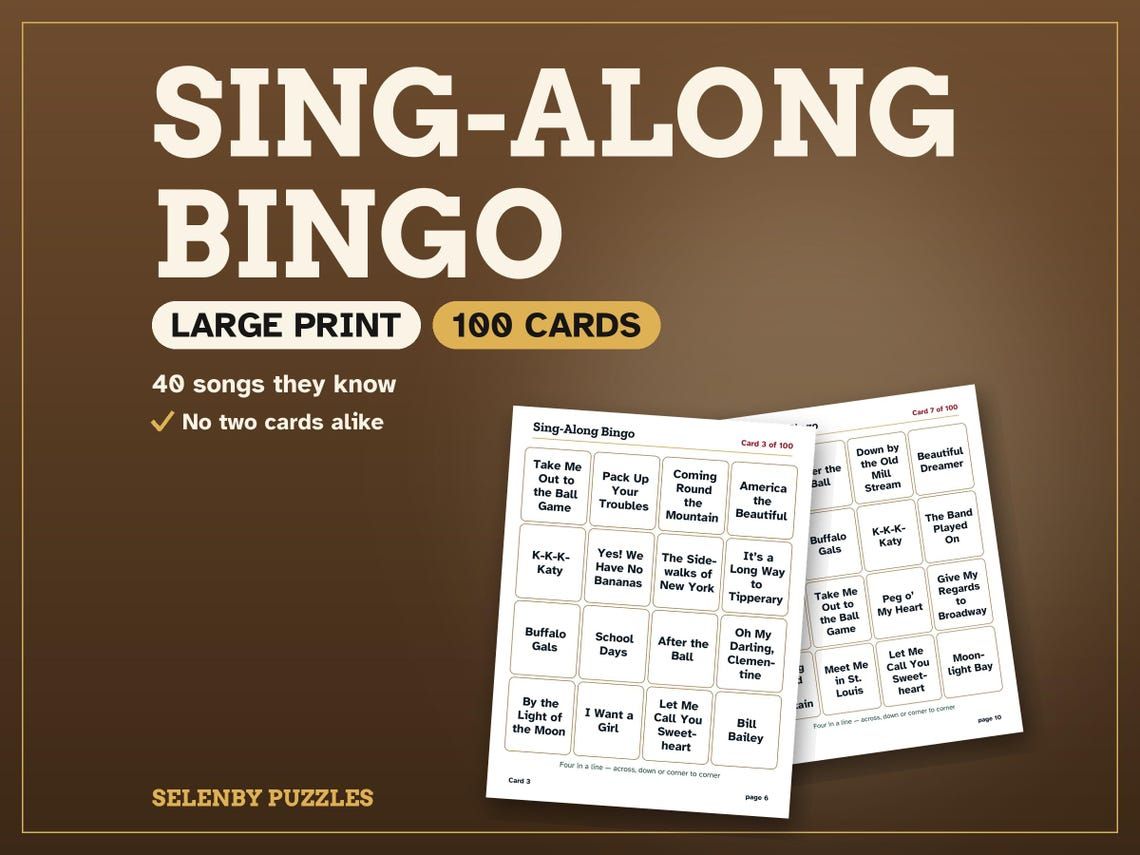
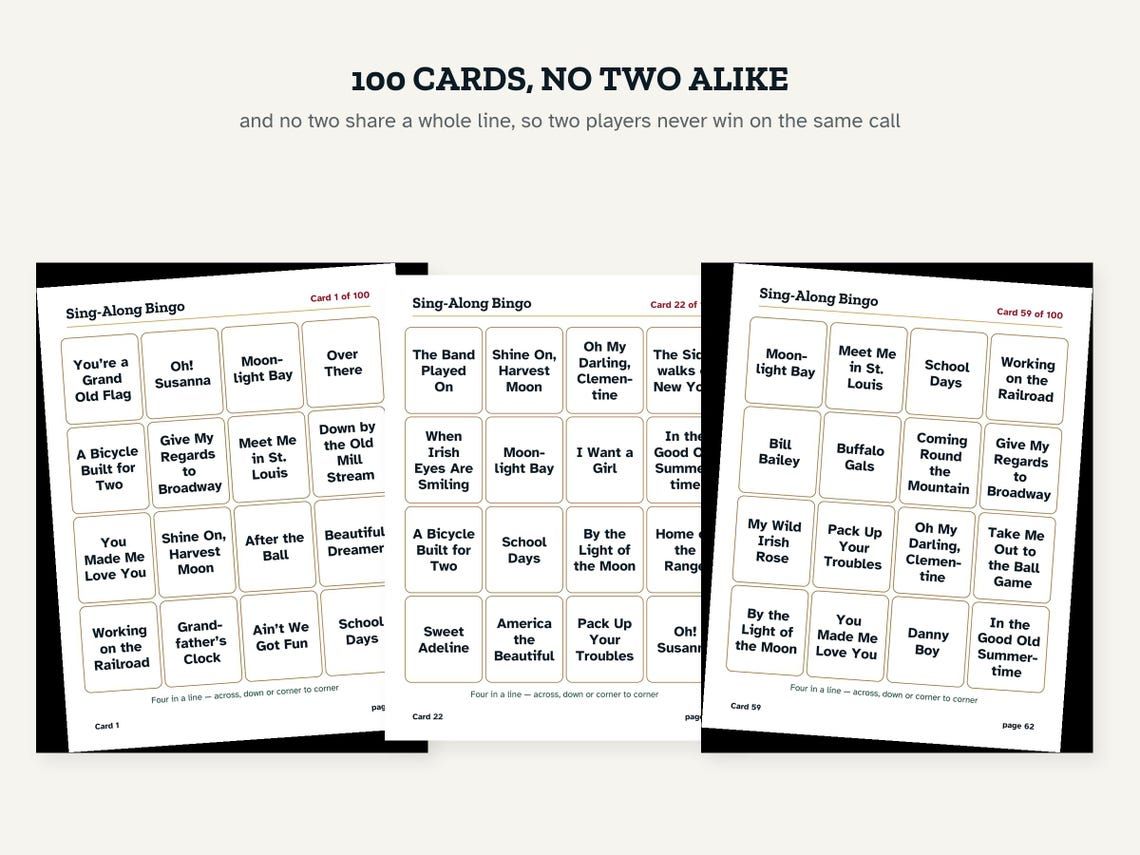
Music starts the week on a warm note. Our Sing-Along Bingo has 100 cards and 40 old-time songs from 1844 to 1923, all in the public domain, with every title on every card set at 23 pt or larger. The host plays or sings a song, says its name, and everyone who has it marks the square.
Vary the length through the month: one line takes about fifteen minutes, two lines about half an hour, and a full card about an hour, usually with the whole room singing.
Tuesday: word search, then talk
Hand out a large print word search and let the room work quietly for fifteen minutes. Then turn the topic into conversation. Our Large Print Word Search has 80 puzzles in four sections of twenty, and the Talk Prompts section is built for exactly this: lists like first cars and schoolhouse days. Solve the page, then ask the room. Words never run backwards, which keeps the search friendly.
Wednesday: a word game in teams
Name 3 is quick and easy to learn: the host reads a category, and players name three things that fit before the count of five. Our Name 3 for Seniors has 72 cards in three levels, so you can start easy and step up as the group warms up. Old Fashioned Sayings is another good Wednesday: the host starts a saying everyone’s grandmother used, and the room finishes it.
Thursday: trivia
Two-choice trivia suits a mixed group: “Which was around first?” Players reason it out together. Our Which Came First Trivia for Seniors has 50 questions in five rounds about everyday American life from the 1870s to the 1980s. Play one round of ten each week and the game lasts five weeks. A and B paddles let everyone answer at once without writing.
Friday: conversation and puzzles
End the week with talk. Two-choice conversation cards ask a question with two answers; the group votes, then a few people share why. Set up a puzzle table alongside it for those who’d rather work quietly: large print sudoku or word search, solved alone or in pairs.
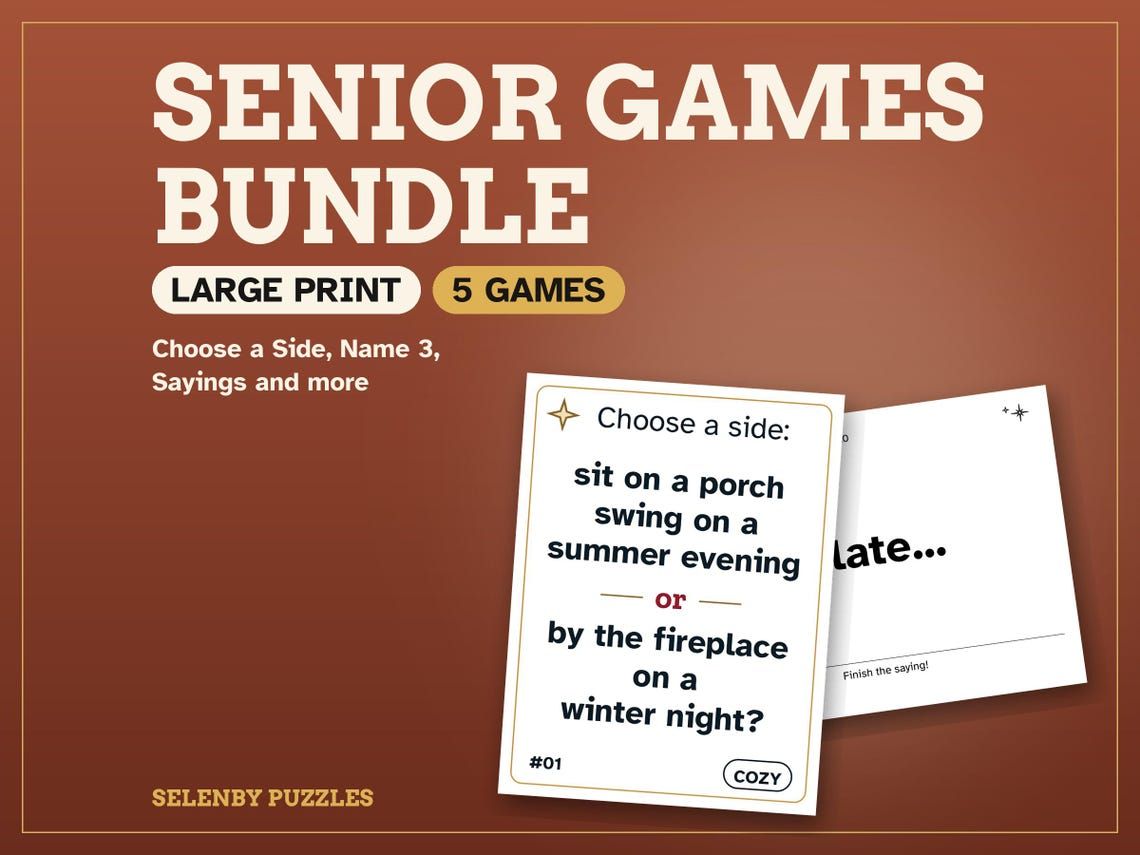
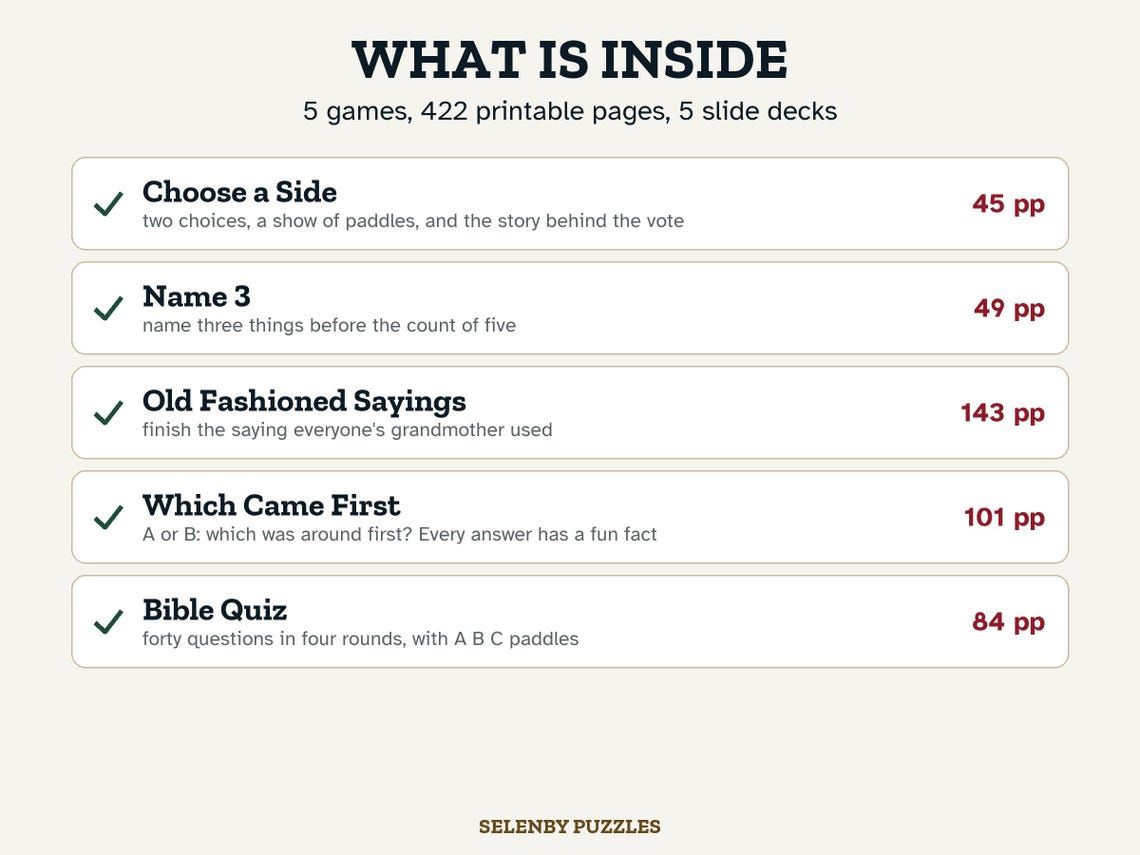
Our Senior Games Bundle brings five of these games together: trivia, sayings, Name 3, a two-choice conversation game and a game of Bible questions.
How to run each session
- Welcome (5 minutes). Greet each person by name and say what today’s activity is.
- Explain once, then demonstrate. Play the first round together, slowly, as practice.
- Play (20 to 30 minutes). Watch the slowest table, not the fastest.
- Talk (5 to 10 minutes). Ask one open question about the topic. Give it time; it’s where the stories come out.
- Close. Thank everyone and say what’s coming next time.
Making every activity accessible
- Seeing. Use large print, black on white, and good light from behind the players, not behind the host.
- Hearing. Face the group, speak slowly, repeat every call or question twice, and use a microphone in a big room.
- Hands. For bingo, buttons are easier to see and to pick up than chips or pens. Card stock is easier to hold than paper.
- Seating. Arrange chairs in a horseshoe so everyone can see the host and each other. Leave room for wheelchairs and walkers.
- Helpers. A volunteer or staff member can mark a card or write an answer for anyone who needs a hand.
- Choice. Invite, never insist. Watching and listening is taking part.
Planning a whole year
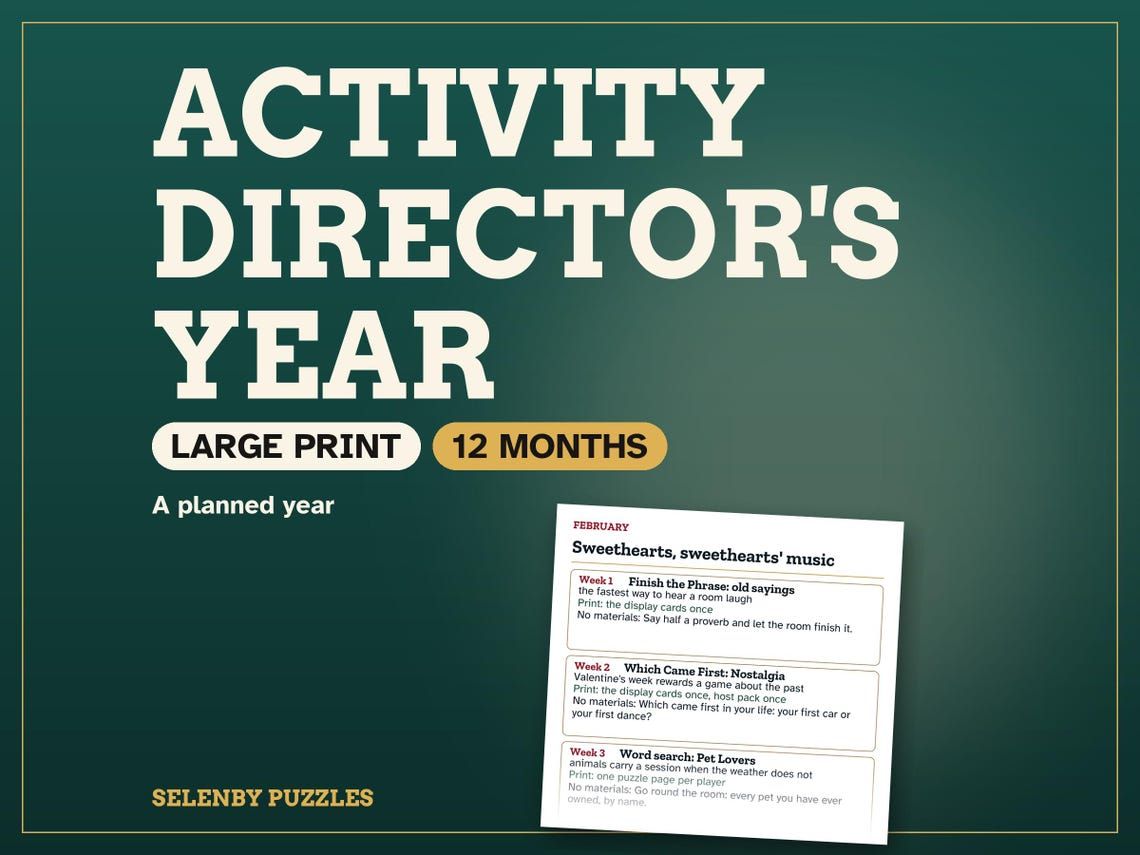
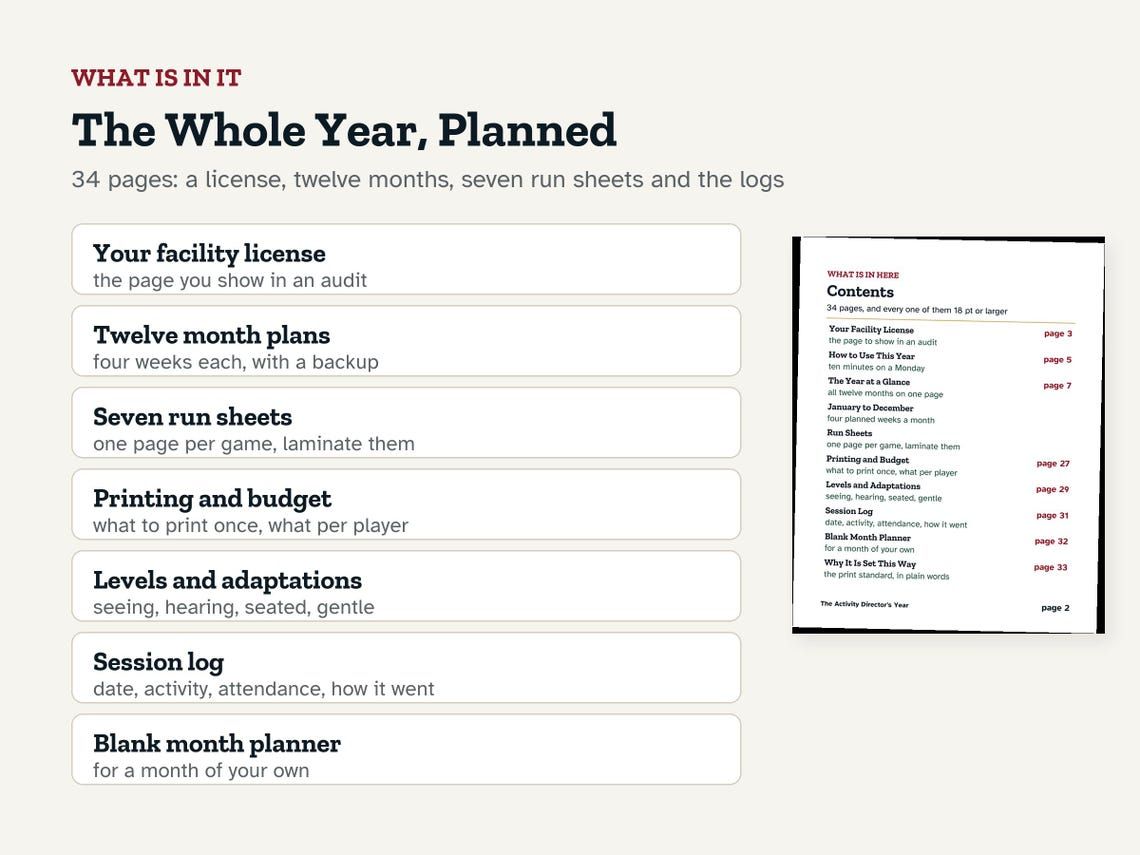
A weekly plan becomes much easier with the whole year mapped. Our Senior Activity Calendar (The Activity Director’s Year) plans 12 months and 48 weeks, with 7 run sheets you can laminate, notes on levels and adaptations for seeing, hearing, seated and gentle play, and a session log. The games themselves are separate downloads, and one license covers your whole building.
Printing on a budget
Print host pages and call sheets once and keep them in a binder. Use the TV slides on a screen instead of printing display cards. Print player cards on card stock and reuse them; sing-along bingo cards can be used week after week. Before printing a stack, print one page at Actual size (100%) to check it; our guide on printing at actual size covers every app and printer.
A good week of activities isn’t about novelty every day. It’s about a rhythm people can count on, with something new inside it. Browse all our games for seniors to fill your calendar.